
Qlik QSDA Secret: One Certification, Exponential Growth

The Qlik QSDA certification, officially known as the Qlik Sense Data Architect certification, stands as a pivotal credential for professionals dedicated to designing, building, and optimizing data models within the Qlik Sense environment. This certification validates an individual's expertise in transforming raw data into powerful, insightful analytical applications, directly impacting an organization's ability to derive value from its information assets. It’s ideal for data architects, developers, and consultants aiming to showcase their proficiency in Qlik Sense data integration and modeling. This article explores the profound value of the Qlik QSDA credential, detailing its structure, the skills it validates, and strategic approaches to preparation, ultimately highlighting its role in accelerating career trajectories.
Achieving Data Model Excellence: The Qlik QSDA Credential
Earning the Qlik QSDA certification signifies a high level of competence in the intricate art of Qlik Sense data architecture. This credential is not merely a badge but a testament to an individual's capacity to handle complex data challenges, from initial requirements gathering to the final validation of data solutions. It positions professionals as authoritative figures capable of driving robust, scalable, and efficient data architectures that underpin critical business intelligence initiatives. Organizations increasingly seek certified experts who can ensure data integrity, performance, and usability, making the QSDA a vital asset in today's data-driven landscape.
Exam Structure and Core Requirements
The Qlik Sense Data Architect exam (QSDA) is designed to rigorously assess a candidate's practical skills and theoretical knowledge. Understanding its components is the first step toward successful preparation and validation of your expertise.
-
Exam Name: Qlik Sense Data Architect
-
Exam Code: QSDA
-
Exam Price: $250 (USD)
-
Duration: 120 minutes
-
Number of Questions: 50
-
Passing Score: 62%
This structure ensures that candidates are thoroughly evaluated across various critical domains, reflecting real-world challenges faced by Qlik Sense Data Architects.
Domain Expertise: Key Syllabus Areas
The Qlik QSDA exam syllabus is meticulously structured to cover the essential competencies required for a data architect. Each section contributes to a holistic understanding of the role, emphasizing both technical skills and best practices. A comprehensive breakdown of the topics helps in prioritizing study efforts and focusing on high-weightage areas. For a deeper dive into each topic, candidates often refer to the detailed Qlik QSDA certification syllabus to ensure they cover all essential content.
-
Identify Requirements (20%): This domain focuses on understanding business needs and translating them into technical data architecture requirements.
-
Data Connectivity (8%): Covers establishing connections to various data sources, including databases, files, and web services.
-
Data Model Design (28%): Emphasizes creating efficient, scalable, and performant data models, including addressing data structures and associations.
-
Data Transformations (38%): The largest section, focusing on cleaning, manipulating, and preparing data using Qlik Sense scripting capabilities.
-
Validation (6%): Involves ensuring the accuracy, completeness, and consistency of the loaded data and the overall data model.
These domains collectively ensure that certified professionals possess the breadth and depth of knowledge necessary to excel in complex data architect roles.
Developing Essential Skills: What Qlik QSDA Validates
The Qlik QSDA credential validates a robust set of skills crucial for anyone working with Qlik Sense. It goes beyond mere technical knowledge, encompassing analytical thinking, problem-solving, and strategic data management. Certified professionals demonstrate the ability to not only write complex scripts but also to design data models that are both efficient and intuitive for end-users. This blend of technical prowess and architectural insight is highly valued across industries, as businesses increasingly rely on accurate and performant data analytics to drive decision-making.
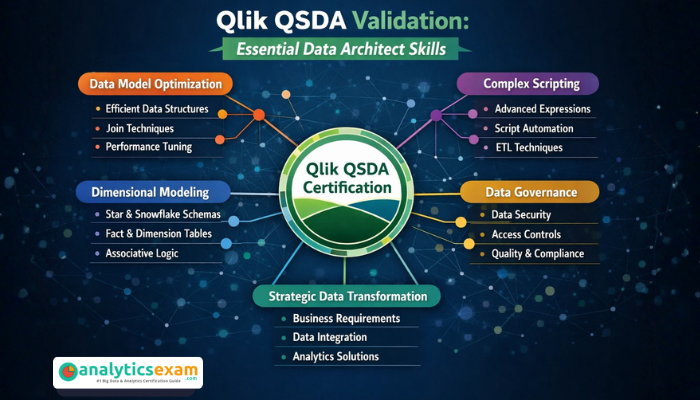
Building Robust Data Models
-
One of the primary capabilities validated by the Qlik QSDA exam is the ability to construct robust and optimized data models. This involves understanding various data modeling techniques and applying them effectively within Qlik Sense.
-
Data Model Optimization: Candidates must demonstrate skills in reducing data footprint, optimizing load times, and ensuring efficient performance for large datasets. This includes techniques like denormalization, synthetic key resolution, and loop detection.
-
Complex Scripting: Proficiency in Qlik Sense script editor, including advanced functions, control statements, and handling incremental loads, is essential. The exam assesses the ability to write clean, maintainable, and efficient data loading scripts.
-
Dimensional Modeling: A deep understanding of star and snowflake schemas, fact and dimension tables, and their application in Qlik Sense is critical for designing user-friendly and high-performing analytical applications.
-
Data Governance Implementation: Knowledge of how to implement data security, row-level access, and data lineage within the Qlik Sense data model ensures data integrity and compliance with organizational policies.
These skills are foundational for any data professional looking to maximize the analytical potential of Qlik Sense.
Strategic Data Transformation
Data transformation is a cornerstone of data architecture, and the Qlik QSDA certification places significant emphasis on a candidate's ability to strategically prepare and manipulate data. This involves more than just cleaning data; it requires foresight into how transformed data will serve analytical needs. Experts can not only automate complex data pipelines but also ensure the resulting data is reliable and fit for purpose. This strategic approach to data manipulation minimizes errors and maximizes the utility of information across the organization, which is a key differentiator for certified professionals.
Advancing Your Career Path with Qlik QSDA
The Qlik QSDA certification serves as a powerful accelerator for career advancement in the competitive field of data analytics. Employers recognize the Qlik QSDA as a benchmark for excellence, indicating that a professional possesses verified expertise in building sophisticated data solutions. This credential can open doors to higher-level roles, such as Senior Data Architect, BI Lead, or specialized Qlik Consultant positions. The demand for skilled data professionals who can efficiently manage and transform data continues to grow, making this certification a strategic investment in one's professional future. It signifies a commitment to mastering a critical aspect of business intelligence, enhancing marketability and earning potential. To explore the broader impact of Qlik certifications on careers, you can visit the official Qlik website.
Preparing Effectively for the Qlik QSDA Exam
Successful preparation for the Qlik QSDA exam requires a structured approach that combines theoretical knowledge with practical application. Merely memorizing facts is insufficient; candidates must develop a deep conceptual understanding of data architecture principles and their implementation in Qlik Sense. Hands-on experience is paramount, as the exam often tests scenario-based problems that mimic real-world challenges. Engaging with the Qlik developer community and working on diverse projects can significantly enhance practical skills and problem-solving abilities. Ethical preparation is key; candidates should avoid any materials that promise "exam dumps" as these can lead to a superficial understanding and undermine the integrity of the certification. Instead, focus on legitimate study resources and practice.
Utilizing Official Resources
-
Leveraging official Qlik resources is crucial for comprehensive and accurate preparation. These resources provide the most relevant and up-to-date information directly from the vendor.
-
Qlik Documentation: The official Qlik Sense documentation is an invaluable resource for understanding every aspect of the platform, from scripting commands to data model best practices.
-
Qlik Learning Paths: Qlik offers structured learning paths and training courses specifically designed for aspiring data architects. These programs provide guided instruction and practical exercises. Explore the official learning catalog for tailored courses.
-
Community Engagement: Participating in the Qlik Community forum allows candidates to ask questions, learn from experienced professionals, and gain insights into common challenges and solutions.
These resources, combined with consistent practice, form the bedrock of a robust preparation strategy.
Hands-On Practice and Scenario-Based Learning
The Qlik QSDA exam tests not just knowledge but the application of that knowledge. Therefore, hands-on practice is indispensable. Candidates should actively build and optimize Qlik Sense applications, experimenting with different data sources, transformation techniques, and data model designs. Working through challenging scenarios, such as resolving synthetic keys or optimizing complex loads, will solidify understanding and prepare you for the practical questions on the exam. Simulation tools and practice exams can also provide a realistic testing environment, helping to identify areas for improvement and build confidence before the actual exam. Engaging in such active learning ensures that your skills are not just theoretical but deeply ingrained.
Conclusion
The Qlik Sense Data Architect (QSDA) certification is a testament to advanced proficiency in Qlik Sense data modeling and transformation, offering unparalleled growth opportunities for data professionals. It validates the critical skills needed to design and implement robust, high-performing data architectures that are essential for modern business intelligence. By earning this credential, individuals not only enhance their technical capabilities but also significantly boost their career prospects, proving their value as indispensable assets in any data-driven organization.
To embark on your certification journey and equip yourself with the knowledge required to excel, it's crucial to utilize high-quality preparation materials. For those ready to elevate their skills and achieve this coveted credential, explore comprehensive study materials and practice tests designed to help you succeed. Prepare effectively for your Qlik Sense Data Architect exam today to unlock new career horizons.
Frequently Asked Questions
1. Who should pursue the Qlik QSDA certification?
The Qlik QSDA certification is ideal for data architects, BI developers, and consultants who are responsible for designing, building, and optimizing data models in Qlik Sense, and who wish to validate their advanced skills.
2. What skills does the Qlik QSDA exam validate?
The exam validates expertise in identifying requirements, data connectivity, advanced data model design, complex data transformations using Qlik scripting, and data validation, crucial for building efficient Qlik Sense applications.
3. How long is the Qlik QSDA certification valid?
Certification validity periods can vary by vendor policy. Qlik typically requires recertification after a certain period, or when a new version of the product is released, to ensure professionals stay current with the latest features and best practices.
4. What are the benefits of becoming Qlik QSDA certified?
Benefits include enhanced career opportunities, increased marketability, higher earning potential, validation of advanced technical skills by a reputable vendor, and improved confidence in handling complex data architecture projects.
5. Is hands-on experience necessary for the Qlik QSDA exam?
Yes, extensive hands-on experience with Qlik Sense, including data loading, scripting, and data model optimization, is critical for success. The exam often includes scenario-based questions that require practical application of knowledge.
- QSDA Questions and Answers |
- Qlik QSDA Certification |
- Qlik Sense Data Architect Certification |
- QSDA Qlik Sense Data Architect Syllabus |
- Qlik QSDA Exam |
- QSDA Qlik Sense Data Architect |
- Qlik QSDA exam syllabus |
- QSDA Qlik Sense Data Architect Questions |
- Qlik QSDA Questions |
- QSDA Qlik Simulator |
- Qlik QSDA Sense Data Architect Sample Questions |
- QSDA Qlik Practice Test |
- Qlik QSDA Sense Data Architect Online Test |
- QSDA Qlik Sense Data Architect Training |
- QSDA Qlik Study Material


