
Talend Data Integration Developer Certification: Is It Worth the Price?
The Talend Data Integration Certified Developer Using Talend Studio exam, run by Qlik under the TDICDTS code, costs USD 250 and earns that back only if Talend Studio is part of the work you actually do. It is a hands-on developer exam, not a management overview, and what you get out of it depends on how closely the ten syllabus topics match your day-to-day job. This guide explains what the exam covers, who should sit it, what the real cost looks like, how the ten objective areas break down, and how to prepare for it in six weeks.
If the exam is already on your calendar, the Talend Data Integration Developer practice exam on AnalyticsExam matches the same 55-question, 90-minute exam, with practice items built around the ten objective areas below. What follows is about that decision: who the credential actually pays off for, and what passing it takes.
What does the Talend Data Integration Developer certification actually prove?
It proves you can build, test and maintain Talend Studio jobs to a professional standard, not just describe data integration in general terms. Qlik, which folded Talend into its own certification programme after acquiring the company, pitches the TDICDTS exam squarely at developers who already work inside Talend Studio day to day, not at architects or managers who only read the diagrams.
The syllabus runs to ten objective areas, and every one of them is something a working Talend developer does rather than something a manager reads about. You need to find your way around the Studio GUI and build a simple Job. You need to configure component properties and schemas, and use the tMap component for mapping, joins and filtered outputs. You need context variables, so the same Job runs across environments without being rewritten. You need error handling: triggers that sequence subJobs, logging components and conditional 'if' triggers built on component variables. You need to work with database metadata, custom SQL queries and generic schemas. You need to orchestrate Jobs, including master Jobs, the order parameters are passed in, and Joblets, plus the parallelization options Studio offers for each. You need to deploy a Job as a standalone package and run it on a remote host. You need project management: local versus remote connections, Git-based revision control and reference projects. And you need to debug a Job using Studio's trace tools.
Qlik recommends at least six months of hands-on experience with Talend products before attempting the exam, together with a general understanding of data integration architecture and advanced features such as parallelization. Pass, and you earn the Talend Data Integration Certified Developer using Talend Studio badge that Qlik issues through its own badging programme, a credential an employer or client can verify independently rather than take on trust. Qlik designs the exam to be hard to pass by reading alone, and the structure of the ten objectives backs that up: each one asks you to have actually done the task in Studio, not merely recognise the name of the feature.
Who gains the most from this certification, and who should think twice?
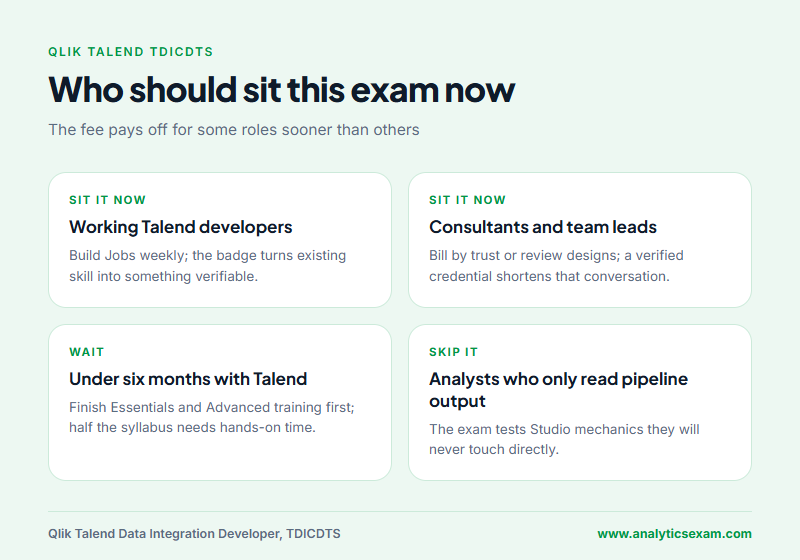
The clearest winners are developers who already spend their week inside Talend Studio and want the fee to buy them something concrete: a credential a hiring manager or client can check without taking their word for it. Close behind are data engineers moving onto Talend from another ETL tool, for whom the exam is a fast, structured way to prove competence rather than accumulate it informally over a year of on-the-job learning. Consultants and contractors who bill by the engagement gain disproportionately, since a verifiable badge shortens the conversation about whether they can be trusted with a client's pipelines. Team leads who review Talend designs without writing every Job themselves also benefit, because the exam forces a working vocabulary for revision control, Joblets and parallelization that makes design reviews faster and more precise.
Two groups should think twice. The first is business or data analysts who only consume the output of pipelines someone else built; the exam tests Studio mechanics they will never touch, and the fee buys them nothing they can use. The second is anyone still inside the six months of hands-on experience Qlik recommends before attempting the exam. Half of the ten objective areas, in particular orchestration, deployment and debugging, are difficult to answer correctly from documentation alone. For that group, the better first move is Qlik's own Talend Studio for Data Integration Essentials and Advanced learning paths, with the exam booked only once those are finished.
For a team rather than an individual, the calculation changes slightly. A manager certifying three or four Talend developers at once is really buying a shared baseline: a guarantee that everyone on the pipeline team can be handed a Job built by someone else and understand the revision-control history, the context-variable setup and the error-handling pattern without a walkthrough. That shared baseline is worth more than any single badge, and it is the strongest argument for certifying a whole team rather than letting individuals decide one at a time.
What format does the exam take, and what does it cost altogether?
| Detail | Talend Data Integration Developer (TDICDTS) |
|---|---|
| Questions | 55 |
| Duration | 90 minutes |
| Passing score | 70% |
| Exam fee | USD 250 |
| Recommended experience | At least six months with Talend products |
| Credential awarded | Talend Data Integration Certified Developer using Talend Studio badge |
The fee itself is the smallest line item. Qlik's own preparation path is two paid learning courses, Talend Studio for Data Integration Essentials and Advanced, plus time spent reading the official Qlik exam details page and the Qlik Learning Catalog and the linked product documentation: the Talend Data Fabric Getting Started Guide, the Studio User Guide, the Software Development Life Cycle best-practices guide, the Components guide, and the separate references for Job examples, logs and errors, and orchestration. None of that is optional reading if you are short on the six months of recommended hands-on experience. The exam fee is also charged per attempt, with no published discount for a retake, which is the clearest reason to rehearse under timed conditions before scheduling a sitting, rather than treating the first attempt as the rehearsal.
Fifty-five questions in ninety minutes gives just under a minute and forty seconds per question, which is comfortable for a definition question and tight for one that describes a Job design and asks which component or setting fixes it. The practical fix is the same one that works for any scenario-heavy exam: answer everything you recognise on the first pass, flag anything that needs you to picture the Studio canvas, and come back to the flagged items once the easy marks are banked.
What does the exam test, domain by domain?
Qlik does not publish a percentage weighting for the Talend Data Integration Developer exam the way it does for some of its platform-wide credentials, so treat every objective area below as equally in scope rather than guess at a split that is not stated anywhere official.
- Getting started with data integration. Define Talend Data Integration, describe the Studio GUI, build a simple Job.
- Working with files. Configure component properties, create and configure a schema, use tMap for a simple mapping, use pre-defined Talend Java functions.
- Joining and filtering data. Configure Talend metadata, join two sources with tMap, set Join and reject-capture behaviour, build filter conditions and reject outputs.
- Using context variables. Define a standard use case, use context variables inside a Job, run the same Job in multiple contexts.
- Error handling. Sequence subJobs with triggers, use logging components, build 'if' triggers from component variables.
- Working with databases. Define database metadata, set table and data actions, customise SQL queries, use metadata and generic schemas in database components.
- Orchestrating Jobs. Master Job use cases, the order parameters are passed, sending dynamic parameters to a child Job, Joblets versus other orchestration primitives, parallelization options and profiling a Job with and without them.
- Deploying Jobs. Build and understand a Job's run options, run a standalone Job, handle context variables standalone, configure and launch on a remote host.
- Project management. Local versus remote connections, Git-based revision control, reference projects and reusing their items.
- Debugging. Debug a Job using Studio's Traces Debug feature.
Two of the ten tend to cost candidates the most marks, and both are a matter of muscle memory rather than theory. The join-and-filter objective asks you to know exactly what the tMap reject-capture mechanism does with a row that fails a condition, which is easy to get backwards if you have only read about it rather than built a Job that uses it. The orchestration objective is the other, because Joblets, master-Job parameter passing and parallelization profiling all touch each other, and a question can describe a symptom in one and expect you to diagnose a cause in another. Candidates who have built at least one multi-Job pipeline with a Joblet inside it consistently find this objective far easier than candidates who have only read the documentation page for it. The fix for both is the same: build the thing once before the exam, rather than read about building it and hope the detail sticks under timed pressure.
What does a six-week study plan look like?
Six weeks works for someone already past the six-month experience mark Qlik recommends. Someone newer to Talend should plan on double that. The schedule below follows the order of the syllabus rather than any stated weighting, at roughly five to six hours a week.
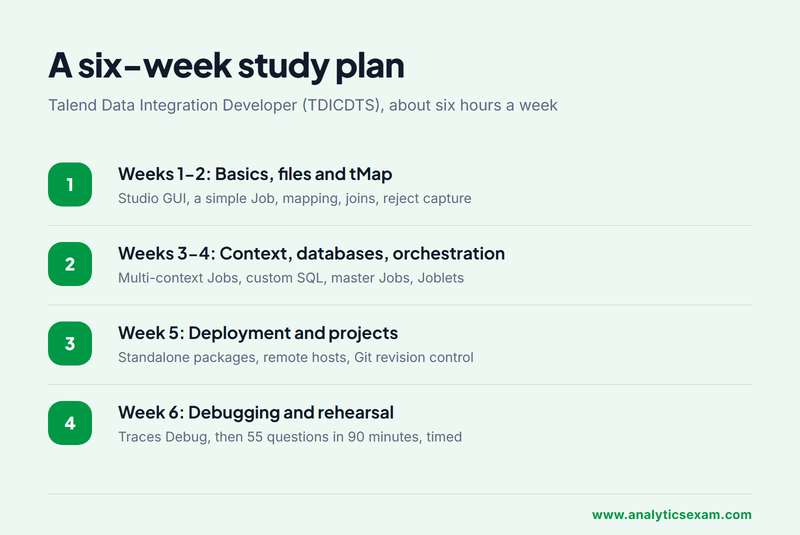
- Week one, the basics. Rebuild the Studio GUI tour from memory, create a handful of simple Jobs, and make sure component properties and schema configuration feel automatic.
- Week two, files and tMap. Practise mapping, joins, the Join reject-capture mechanism, and filter conditions with multiple filtered outputs until tMap stops feeling like the hardest part of the exam.
- Week three, context and databases. Run one Job across at least three contexts, then repeat the same exercise against a database source: metadata, custom SQL and generic schemas.
- Week four, error handling and orchestration. Build a master Job that calls at least two child Jobs, pass dynamic parameters between them, and convert part of it into a Joblet.
- Week five, deployment and project management. Package a Job as standalone, run it on a remote host, and practise the Git-based revision-control operations: check-in, check-out and working from a reference project.
- Week six, debugging and rehearsal. Debug a deliberately broken Job with Traces Debug, then sit full-length timed rehearsals, 55 questions in 90 minutes with nothing open, and review every wrong answer against the Studio documentation rather than guessing why it was wrong.
Qlik's own recommendation is to take the Talend Studio for Data Integration Essentials and Advanced learning paths, work through the Talend Data Integration Certified Developer preparation training modules, and get comfortable searching the Qlik Talend Help Center and Qlik Community knowledge base for anything the documentation does not answer directly. None of that replaces the sixth week. A timed rehearsal is the only way to find out whether ninety minutes is actually enough time for you, and the TDICDTS exam syllabus page on AnalyticsExam lists the same ten objective areas alongside sample questions if you want a second source to study against.
The most common preparation mistake is treating weeks one through five as reading weeks and leaving every hands-on exercise for week six. The exam rewards people who have made the mistakes already, inside Studio, where getting a Join reject-capture setting wrong just means re-running a Job rather than losing a mark. Build something small every week rather than reading about it and planning to build it later; the plan rarely survives contact with week six.
How does this certification compare with the other Talend and Qlik credentials?
TDICDTS sits in a cluster of Talend credentials that Qlik kept after the acquisition, and the names are easy to confuse because they share a prefix. The Talend Big Data Developer Using Talend Studio exam (TBDCDTS) is the closest relative: same Studio, same developer-level depth, but aimed at big-data-specific Jobs rather than general data integration, so the two rarely overlap in practice even though the syllabus structure looks similar on paper. The Talend Data Integration Administrator exam (TDICA) is a different job entirely, covering installation, server management and platform operations rather than building Jobs, and it suits the person who keeps a Talend environment running rather than the person who develops inside it. The Talend Data Quality Implementer (TDQCI) and Talend Data Catalog Implementer (TDCCI) exams are narrower still, each certifying one specific Talend product rather than the whole Studio. The Talend API Services Developer (TAPISCD) and Talend Cloud Administrator (TCCA) exams round out the set, one for API-first integration work and one for the cloud platform specifically.
For most developers the sensible order is to earn TDICDTS first, because it is the general developer credential the others assume you already have the instincts for, and only add TBDCDTS, TDQCI or TDCCI once a specific part of the job calls for it. Administrators should start with TDICA instead and treat TDICDTS as optional unless they also build Jobs themselves. Whichever credential comes first, the preparation habits in this guide, hands-on practice ahead of documentation, a timed rehearsal before the real sitting, carry over to every exam in the family, which is the main reason earning one well tends to make the next one faster to earn.
What should you do with the badge once you have it?
Earning the exam gets you the Talend Data Integration Certified Developer using Talend Studio badge, issued through Qlik's badging programme and independently verifiable, which is most of its value: a hiring manager or client no longer has to take your Talend skills on trust. Put it where decisions get made. On a CV or LinkedIn profile it belongs in the certifications section with the full badge name rather than the bare code, since a hiring manager searching for Talend skills is more likely to search the product name than the exam code. In an internal profile, link the badge to the pipelines you have actually built, not just to the exam date.
Then decide what it leads to. Developers who work mostly with large or streaming datasets usually add TBDCDTS next. Those moving toward platform ownership add TDICA. Everyone else gets more value from depth than from another badge: Talend Studio changes between releases, and a developer who last opened the documentation on exam day stops matching the certification within a couple of release cycles. An afternoon with the release notes each quarter is enough to keep the badge honest, and it is a far smaller time cost than re-sitting an exam you have already passed once.
One habit is worth carrying past the exam itself: keep a short written record of every Job design decision you make, including why a Joblet was used instead of a duplicated subJob, or why a remote connection was configured one way rather than another. The TDICDTS syllabus rewards exactly that kind of reasoning, and a team that writes it down once a project ends up re-certifying new members faster than a team that only has the exam badge to point to.
Frequently Asked Questions
Is the Talend Data Integration Developer certification worth the USD 250 price?
Yes, if Talend Studio is part of your actual job. The exam fee is small next to the time Qlik's own recommended preparation takes, so the real return comes from whether a verifiable developer credential changes hiring conversations or client trust in your work, not from the exam fee itself.
How many questions are on the TDICDTS exam and how long do I have?
The exam has 55 questions and runs for 90 minutes. There is no published breakdown of question types beyond that, so treat the ten syllabus objective areas as equally in scope rather than assume any one of them carries more weight than another.
What is the passing score for the Talend Data Integration Developer exam?
Qlik sets the passing score at 70%. The exam content and difficulty can change as Qlik updates it, and the passing score is adjusted to keep the standard consistent, so the figure to plan around is the published 70% rather than an informal pass mark you may read elsewhere.
Do I need prior Talend experience before taking this exam?
Half a year of hands-on Talend Studio use is the baseline Qlik points to, together with a general grasp of data integration architecture and features such as parallelization. Several of the ten objective areas, orchestration especially, are hard to answer correctly from documentation alone without that practical time.
Does Qlik offer an official practice test for this certification?
Qlik does not publish a full official practice exam. Its own preparation path runs through the Talend Studio for Data Integration Essentials and Advanced learning paths, the listed product documentation, and the Qlik Community knowledge base. AnalyticsExam separately sells a 55-question, 90-minute rehearsal built to match the real exam, but it is not Qlik material.
How does the Data Integration Developer certification differ from the Talend Big Data Developer certification?
Both are Studio-based developer exams at a similar level, but TDICDTS covers general data integration Jobs while the Big Data Developer exam (TBDCDTS) focuses on big-data-specific Jobs. Most developers earn TDICDTS first and add TBDCDTS only once their work actually involves big-data pipelines.


