
Cloudera CDP Generalist Certification: Is It Worth It for Your Career?
The Cloudera CDP Generalist certification is worth it if your job touches the Cloudera platform from more than one side. It is the one Cloudera credential that is not tied to a single role, which is exactly why administrators, developers, analysts, data engineers and data scientists all sit it. This guide explains what it proves, who gains most from it, how the exam is built, and how to prepare without wasting weeks.
If you have already decided to sit the exam and want a realistic rehearsal, the Cloudera CDP-0011 practice exam on AnalyticsExam mirrors the 60-question, 90-minute format with a question bank of more than 280 items. The rest of this article is about the decision itself: whether a platform-wide credential moves your career, and what it takes to earn one.
What does the Cloudera CDP Generalist certification actually prove?
It proves that you understand how the whole Cloudera platform fits together rather than how one corner of it works. Cloudera describes the exam as a test of general, broad knowledge, and it deliberately keeps it open to multiple roles. Every other credential in the Cloudera programme is role-based. The administrator exams go deep on cluster operations, the data engineer exam on pipelines, the machine learning engineer exam on model lifecycle. The Generalist sits above all of them and asks whether you can explain the moving parts to each other.
In practice that means five areas of knowledge. You need to know the deployment forms the platform ships in, which are Cloudera on cloud, Cloudera Base on premises and Cloudera Data Services on premises. You need the runtime concepts underneath every workload, from YARN scheduling and data access through the operational database, streams messaging, the open data lakehouse, Replication Manager and virtual private clusters. You need the cloud control plane, meaning Data Catalog, Cloudera Observability, the Management Console and Data Hub. You need the Shared Data Experience, which is the security and governance layer built from Apache Ranger, Apache Atlas, Apache Knox and the Data Catalog. And you need the data services themselves: Data Engineering, Data Warehouse, Operational Database, Cloudera AI and Data Flow.
None of those areas is tested to the depth a specialist would face. What is tested is whether you can place a feature in the right layer, say what problem it solves and recognise when a scenario calls for it. That is the definition of a generalist, and it is a genuinely useful thing to be able to prove, because most of the friction in a data platform team comes from people who only understand their own layer.
Who gains the most from a platform-wide Cloudera credential?
The people who gain most are the ones whose work crosses team boundaries. Cloudera lists five audiences for the exam, and each has a different reason to care.
- Administrators run the clusters and the control plane, but increasingly field questions about why a data service behaves the way it does. Knowing the services as well as the infrastructure makes those conversations shorter.
- Developers build against the runtime and the data services. Understanding SDX governance and the deployment model stops a working prototype from stalling at the security review.
- Data analysts consume the Data Warehouse and the catalog. A broad view of lineage, access control and where data lands means fewer tickets raised and faster answers to the business.
- Data engineers live in Data Engineering, Data Flow and the lakehouse, yet their pipelines fail at the edges where storage, security and scheduling meet. The Generalist covers those edges.
- Data scientists work in Cloudera AI and need governed access to data they did not create. The credential explains the path from raw table to approved feature set.
There are two other groups the vendor does not name but who sit the exam in numbers. The first is solution architects and pre-sales engineers, for whom a platform-wide credential is close to a job requirement. The second is managers and team leads who no longer write code but who approve designs. For both, the Generalist is a faster and more honest signal of competence than any single role-based exam, because it tests the breadth the job actually demands.
Who gains least? A deep specialist who is already certified in their role and has no intention of moving. If you are a Cloudera data engineer who wants to stay a data engineer, the role exam you already hold says more about you than the Generalist will. Even then, the Generalist is a reasonable second credential, because it is cheaper in study time than any of the role exams and it rounds out a profile that otherwise reads as narrow.
How is the exam structured, and what does it cost?
The exam is short, timed and delivered online. Cloudera publishes the format on its exam guide, and the figures below are taken from there and from the AnalyticsExam exam summary as of October 2026.
| Detail | Cloudera CDP Generalist |
|---|---|
| Questions | 60 |
| Duration | 90 minutes |
| Delivery | Online, proctored through Questionmark |
| Allowed resources | None. No documentation, white papers or notes |
| Exam fee | USD 330 |
| Audience | Administrator, developer, data analyst, data engineer, data scientist |
| Result | Pass or fail against the pass mark Cloudera states on its exam guide |
Sixty questions in ninety minutes gives you a minute and a half per question, which is generous for recall items and tight for scenario items that describe a deployment and ask which component solves the stated problem. Candidates who run out of time are almost always the ones who re-read every scenario twice. The fix is a first pass that answers everything you know on sight, flags the rest and returns to the flagged items with whatever time remains.
The online proctoring matters more than people expect. You will need a quiet room, a working webcam, a machine that meets the Cloudera exam guide system requirements and no second monitor. Check all of that a week before the exam date rather than on the morning. The fee is non-trivial, so a technical failure on the day is an expensive way to learn that your laptop camera does not meet the specification.
Which exam domains carry the most weight?
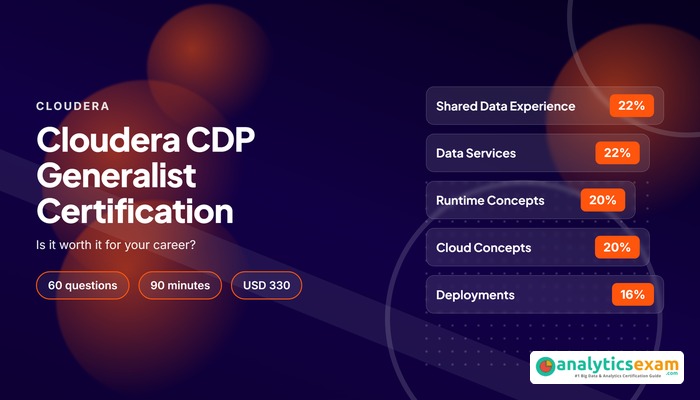
Cloudera publishes five topic areas with explicit weightings, and the two heaviest together make up almost half the paper. The weightings are from the vendor's exam guide and are mirrored on the syllabus page for this exam on AnalyticsExam.
- Cloudera Shared Data Experience, 22 percent. Apache Ranger for authorisation, Apache Atlas for metadata and lineage, Apache Knox for perimeter security, and the Data Catalog that sits on top of them. Expect questions that describe a governance requirement and ask which component enforces it.
- Data Services, 22 percent. Cloudera Data Engineering, Data Warehouse, Operational Database, Cloudera AI and Data Flow. Expect questions that describe a workload and ask which service fits.
- Cloudera Runtime Concepts, 20 percent. YARN, data access, the operational database, streams messaging and stream analytics, the open data lakehouse, Replication Manager and virtual private clusters. This is the most technical domain and the one where administrators have the edge.
- Cloudera on Cloud Concepts, 20 percent. Data Catalog, Cloudera Observability, the Management Console and Data Hub. This is the control plane, and candidates who have only worked on premises find it the least familiar.
- Cloudera Deployments, 16 percent. The three ways the platform is installed and run: in the public cloud, as Base on your own hardware, or as Data Services on your own hardware. Smallest domain, but the one that frames every scenario, so weak answers here tend to drag down the others.
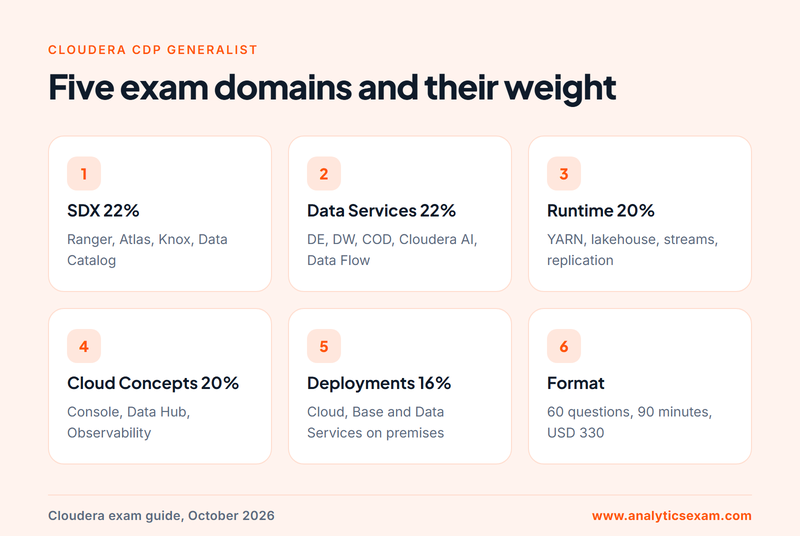
Notice what that distribution says about the exam's intent. Forty-four percent of the marks are for governance and for choosing the right data service, which are decisions made at design time, not keystrokes made at a terminal. Only a fifth of the paper, the runtime domain, rewards hands-on operational depth. If your preparation is mostly cluster administration, you are optimising for the wrong fifth.
Which domain is hardest, and does it depend on your background?
It depends almost entirely on where you come from, and the pattern is consistent enough to plan around.
Administrators find the runtime and deployment domains straightforward and struggle with the data services. They know how to keep a cluster healthy but have rarely built a pipeline in Data Engineering or trained a model in Cloudera AI, so service-selection questions feel like guesswork. The remedy is to spend a weekend inside each data service's documentation and build one trivial artefact in each.
Developers and data engineers are the reverse. They know the services intimately and have never had to think about Knox topologies or Replication Manager policies. For them the SDX domain, the heaviest on the paper, is the risk. Reading the Ranger and Atlas concept pages once is not enough; you need to be able to say, for any given policy, which component evaluates it and at what point in the request.
Analysts and data scientists usually find the cloud concepts domain hardest. The Management Console, Data Hub and Observability are things a platform team sets up for them, so the vocabulary is unfamiliar. The good news is that this domain is mostly vocabulary. Once you can describe what each console does and how an environment, a data lake and a Data Hub cluster relate, the questions become readable.
Everyone, regardless of background, underestimates the deployment domain because it is the smallest. Do not. The difference between Cloudera Base on premises and Cloudera Data Services on premises is subtle, it appears in the framing of many scenario questions, and getting the frame wrong costs marks in other domains too.
How do you prepare for the exam in six weeks?
Six weeks is enough for someone who already works with the platform. Someone new to Cloudera should double it. The plan below assumes about six hours a week and follows the weighting of the paper rather than the order of the documentation.
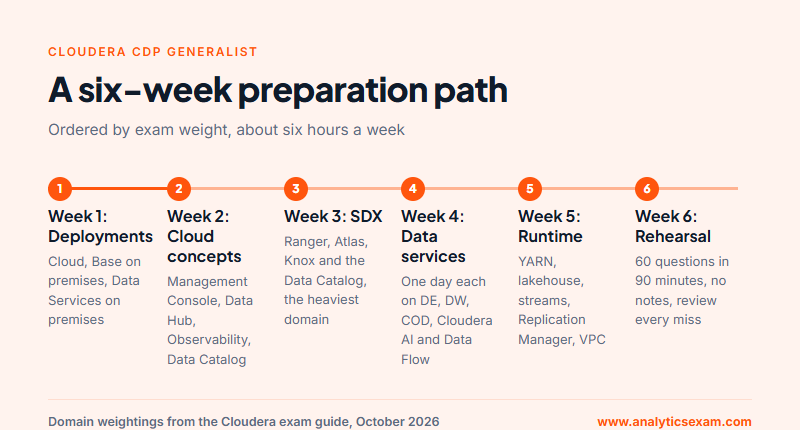
- Week one, deployment forms. Read the Cloudera deployment overviews until you can draw the three forms from memory and name what is shared and what differs. Short domain, but it is the frame for everything else, so it goes first.
- Week two, cloud concepts. Work through the Management Console, Data Hub and Observability documentation. If you have access to a trial environment, create one Data Hub cluster and find every setting you read about.
- Week three, Shared Data Experience. The heaviest domain gets a full week. Ranger policies, Atlas classifications and lineage, Knox gateways and the Data Catalog. Write a one-page summary of which component does what; if you cannot, you are not ready for this domain.
- Week four, data services. One day each on Data Engineering, Data Warehouse, Operational Database, Cloudera AI and Data Flow. The question you must be able to answer for each is simply: what workload does this exist for, and what would you not use it for.
- Week five, runtime concepts. YARN, the lakehouse, streams messaging, Replication Manager and virtual private clusters. Administrators can compress this week; everyone else should not.
- Week six, timed rehearsal. Sit full-length practice exams under exam conditions, 60 questions in 90 minutes with no notes, and review every wrong answer against the documentation. Repeat until your weakest domain stops being the one that decides the result.
Cloudera recommends its own instructor-led Cloudera training, and the Cloudera Essentials course maps closely to the Generalist syllabus. It is the right choice if your employer funds it and you are new to the platform. It is not a substitute for the sixth week. Nothing reveals a gap like a timed paper, and the only way to find out whether you misread scenarios under pressure is to answer sixty of them against a clock.
Two habits make the difference in the final week. First, answer every practice question by eliminating the layers that cannot be right before you look for the one that is; the exam is built around layers, and that habit turns a four-option guess into a two-option decision. Second, keep a running list of every term you had to look up. If that list is still growing on the day before the exam, move the date. The fee is the same whether you pass or not.
How does the Generalist compare with the role-based Cloudera exams?
The Generalist is broader, shorter to prepare for and less prescriptive about what you do next. The role-based exams, which cover the on-premises administrator, the public cloud administrator, the data engineer, the data analyst, the data operator and the machine learning engineer, each go deep on one job and expect you to have done that job.
A sensible way to think about the two tiers is as a map and a route. The Generalist is the map: it proves you know where everything is. A role exam is a route: it proves you can get a specific kind of work done. Most careers want the map first, because a route is far easier to learn once the map is in your head, and because the map is the thing you will still need when you change roles.
So which should you take first? If you have less than a year on the platform, start with the Generalist; the role exams assume context you do not yet have. If you have several years in one role and want recognition for it, take the role exam first and add the Generalist later to show breadth. If you are moving between roles, which is the most common reason people search for this credential, the Generalist is the one that speaks to the job you are moving into rather than the one you are leaving.
There is also a cost argument. Every Cloudera exam carries a fee, and failing a role exam because you lacked platform context is an avoidable expense. The Generalist removes that risk for the role exams that follow it. For teams certifying several people, that alone usually justifies putting the Generalist first.
What happens after you pass, and how do you make the credential count?
Passing gives you a credential that Cloudera issues and that an employer can verify, and the exam guide explains how results and verification are handled. What you do in the first month after passing determines whether it changes anything.
Put the credential where decisions are made. On a CV it belongs in the headline block, not in a list at the bottom, and it should be described as a platform-wide credential across deployment, governance, runtime and data services rather than as an exam code. In an internal profile, link it to the projects where you have actually used the breadth it certifies. In interviews, use it to open a conversation about architecture rather than to close one about qualifications.
Then decide what it is a step toward. For many candidates the answer is one of the role exams, and the week-by-week notes you made for the Generalist are the start of that preparation. For others it is a move into architecture or platform leadership, where the Generalist is often the only Cloudera credential that is directly relevant. For a smaller group it is simply the end of the formal path, and a credential that keeps answering the question of whether you understand the platform is a reasonable place to stop.
Whichever it is, keep the knowledge current. The platform changes, the exam guide is revised to follow it, and a Generalist who last read the documentation on the day of the exam stops being a generalist within a couple of release cycles. Half a day a quarter with the release notes is enough to keep the map accurate.
Frequently Asked Questions
Is the Cloudera CDP Generalist certification worth it for someone new to Cloudera?
Yes, and it is usually the right first credential. The exam tests broad platform knowledge rather than hands-on depth in one role, so a newcomer can prepare for it in roughly twelve weeks and come away with the context the role-based exams assume. It also costs less study time than any role exam.
How many questions are on the Cloudera CDP Generalist exam and how long is it?
The exam has 60 questions and lasts 90 minutes. It is delivered online under proctoring through Questionmark, and no reference material of any kind is permitted. Cloudera publishes the current format, pass mark and system requirements on its exam guide, and AnalyticsExam mirrors the format in its practice exam.
How much does the Cloudera CDP Generalist exam cost?
The exam fee is USD 330 as of October 2026, payable to Cloudera when you register. The fee is charged per attempt, so a failed sitting costs the same as a pass. That is the strongest practical argument for a timed rehearsal before you book, rather than treating the first attempt as a trial run.
Which Cloudera CDP Generalist exam domain has the highest weighting?
Two domains tie for the highest weighting at 22 percent each. Shared Data Experience covers Ranger, Atlas, Knox and the Data Catalog, and Data Services covers Data Engineering, Data Warehouse, Operational Database, Cloudera AI and Data Flow. Runtime concepts and cloud concepts carry 20 percent each, and deployments carry 16 percent.
Does Cloudera offer an official practice test for the CDP Generalist exam?
Cloudera's own preparation material is the exam guide, the documentation it links and its instructor-led training such as Cloudera Essentials. Cloudera does not publish a full-length sample paper. The AnalyticsExam practice exam is an independent product that reproduces the 60-question, 90-minute format for timed rehearsal; it is not Cloudera material.
Should I take the Cloudera CDP Generalist exam before a role-based Cloudera exam?
Take the Generalist first if you have under a year on the platform or are moving between roles. Take a role exam first when you already have deep experience in that one job and want it recognised. Either way the Generalist reduces the risk of failing a role exam for lack of platform context, which is an avoidable fee.


