
Cloudera On-Premises Administrator Certification: What It Tests and Who Should Sit It
The Cloudera Administrator on premises exam is a 90-minute, 80-question online test, priced at USD 330, that checks whether you can install, secure, operate and maintain a Cloudera cluster running in your own data centre. Cloudera's exam guide lists a pass score of 60, and the questions are spread over nine weighted topics, from architecture and high availability through Kerberos, Ranger and Atlas to HDFS and YARN administration. If you already run Cloudera Manager for a living, a timed Cloudera Administrator on premises practice exam will show you quickly which of those nine topics you can skip and which still need work.
What does the Cloudera on-premises administrator credential actually certify?
Cloudera's own wording is short: the exam tests the skills a system administrator needs to manage and maintain Cloudera on premises. That is broader than it sounds. A cluster that lives in your own racks has no cloud control plane to lean on, so the administrator owns everything from the Linux hosts upward: the database behind Cloudera Manager, the parcels that carry Cloudera Runtime, the TLS certificates on every service, the Kerberos realm, the Ranger policies, the YARN queues and the backup schedule. The credential says you can do all of that without breaking the cluster for the analysts and engineers who depend on it.
It is a product-specific credential, not a vendor-neutral one. The questions assume Cloudera Manager and Cloudera Runtime, the 7.1.x line of the private cloud base platform, and they use Cloudera's names for things. Someone who has run a bare Apache Hadoop cluster will recognise most of the concepts but will still have to learn how Cloudera wraps them: where Auto-TLS puts its certificates, how parcels differ from packages, which page of Cloudera Manager shows a stale configuration, and what the REST API expects when you script a restart.
Cloudera also states the prerequisites it does not test directly but expects you to have: Linux system management, network security such as SSL and TLS, authentication and authorisation with Kerberos and LDAP, and relational database management. None of these get their own topic, yet several questions in the security and installation sections are only answerable if you understand them. A candidate who has never debugged a Kerberos ticket or restored a PostgreSQL database will find those questions harder than the weightings suggest.
Who should sit this exam, and who should wait?
The clearest fit is the administrator who already looks after one or more Cloudera clusters on physical or virtual hosts inside a company network. Banks, telecoms, public-sector bodies and manufacturers still run large on-premises estates because of data residency rules, latency or sunk hardware cost, and they employ dedicated platform teams to keep those clusters healthy. For that administrator the exam mostly confirms what the job already demands, and the preparation is a matter of filling the gaps in the topics they touch least often, usually governance and capacity planning.
The second fit is the consultant or systems integrator who installs and hardens Cloudera for clients. Here the credential has commercial value: a customer choosing between two partners will often ask how many certified administrators each one can put on the project. Cloudera's partner programmes count certifications, and a consultant with the on-premises administrator credential and the security course behind it can lead an installation rather than assist on one.
The third group is the Linux or storage administrator being moved onto a data platform team. Their Linux, networking and database knowledge covers the prerequisites, and the exam gives them a structured way to learn the Cloudera layer on top. They should expect to spend longer in preparation than the first two groups because every topic is new to them, but the credential is a sensible six-month goal for that move.
Three kinds of candidate should wait or choose a different exam. Data engineers and analysts who write Spark or Hive jobs but never touch Cloudera Manager will find the content far from their daily work; the Data Engineer and Data Analyst exams fit them better. Administrators whose entire estate runs on Cloudera's public cloud offering should look at the public cloud administrator exam instead, because this one is explicitly about on-premises deployments. And anyone with less than a few months of hands-on time with Cloudera Manager should get that time first, since roughly half of the questions describe situations that only make sense once you have clicked through the console yourself.
How is the exam set up: questions, time, fee and pass score
The structure is plain. You get 80 questions and 90 minutes, which works out at a little under 70 seconds per question. That pace matters more on this exam than on many others, because several questions describe a configuration or a failure in a few sentences and ask what you would change; reading carefully and answering once is the only way to stay on schedule. The exam fee is USD 330, and the pass score published in Cloudera's exam guide is 60.
Delivery is online and proctored through Questionmark, so you sit it from your own machine with a webcam and a clean desk. Cloudera's exam guide is specific that no resources are allowed: no documentation, no white papers, no user guides and no notes. Check the proctoring system requirements before the day rather than on it, because a failed system check costs you the slot.
Questions are multiple choice and multiple response. There is no hands-on lab component, which is a relief to some candidates and a frustration to others. In practice it means the exam rewards knowing which setting lives where and what a given error indicates, rather than typing speed at a terminal. It also means you can prepare without a production cluster, as long as you have somewhere to install a small one.
Cloudera does not publish a retake policy on the exam guide page, and it does not say how many of the 80 questions are unscored. Treat every question as if it counts, and plan your preparation so that one attempt is enough; a second fee doubles the cost of the credential.
Which of the nine topics carry the most weight?
Cloudera lists nine topics with their share of the exam. Architecture is the single largest at 14 percent. Four topics follow at 12.5 percent each: planning high availability, installation and deployment, managing and operating clusters, and security configuration. Three sit at 10 percent each: governance, capacity management, and administering HDFS and YARN. Cluster maintenance, which covers upgrades and patches, is the smallest at 6 percent.
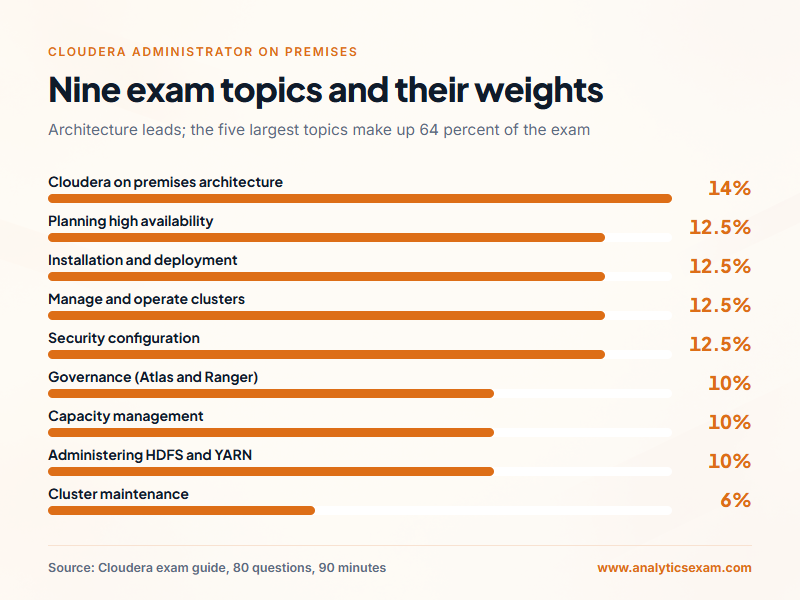
Read together, the weightings tell a story. The five largest topics add up to 64 percent of the exam, and they are all about standing a cluster up correctly and keeping it running: understanding how Cloudera Manager and the platform fit together, planning availability and backups, installing Cloudera Manager, core services and parcels, operating the cluster through the console and its REST API, and locking it down with Auto-TLS, Kerberos, users, groups and encrypted traffic. If you only have time to be excellent at some of the syllabus, be excellent at those five.
The architecture topic deserves extra attention because it is both the largest and the one experienced administrators most often skip. It covers the architecture of the data platform and of Cloudera Manager, designing for security, planning a deployment and the requirements of an isolated network with no outbound internet access. The last item is a real on-premises concern: many regulated sites cannot let hosts reach Cloudera's download servers, so you need to know how a local parcel repository and an internal package mirror are set up and kept current.
The security topic is worth reading in full. Auto-TLS, Kerberos installation and configuration, user and group management and network encryption each appear as named objectives. Questions here tend to be practical: what Auto-TLS generates for you and what it does not, which principals Cloudera Manager creates when you enable Kerberos through the wizard, and where encryption of data in transit is switched on for a given service.
Governance at 10 percent covers installing Atlas and configuring its classifications, installing and using Apache Ranger, and managing risk. Administrators who inherited a cluster with Ranger already in place often know how to write a policy but not how the components were installed or how Atlas tags flow into Ranger's tag-based policies. Capacity management, also 10 percent, is about inspecting and extending capacity and maintaining host nodes: adding hosts, decommissioning them cleanly, and watching the signals that say a cluster is running out of room. HDFS and YARN administration rounds out the practical side with the commands and settings that keep the file system balanced and the scheduler fair.
Cluster maintenance at 6 percent is small but not optional. Upgrading Cloudera Manager and Cloudera Runtime, and applying patches, come with an order of operations that the exam can ask about directly, and a candidate who has only ever done a fresh install will not know it.
Where do experienced Linux administrators lose marks?
The candidates who struggle most are rarely the ones short on fundamentals. They are the strong Linux administrators who assume the Cloudera layer is thin. Three patterns show up again and again in failed first attempts.
The first is treating Cloudera Manager as a convenience rather than the system of record. On this platform the console and its agents own the configuration; editing a file by hand on a host is undone at the next redeploy, and the exam expects you to know that and to know where the equivalent setting lives in the console. Questions about stale configurations, safety valves and configuration redeployment catch people who still think in terms of files.
The second is underestimating the Kerberos and TLS material. Administrators who have enabled Kerberos once, through the wizard, usually cannot explain what the wizard did. The exam asks about principals, keytabs, the KDC relationship and what breaks when a host's time drifts, and it asks about Auto-TLS in the same spirit. Spending an afternoon reading the security documentation and then re-enabling both features on a lab cluster, watching what gets created, closes most of that gap.
The third is skipping governance because it feels like someone else's job. On many teams a data governance group owns Ranger policies and Atlas classifications, so the administrator never installs or configures either. The exam does not care who owns it in your company; it asks the administrator to install Atlas, configure classifications, install Ranger and reason about risk. Ten percent of the exam is roughly eight questions, and eight questions is the difference between passing comfortably and missing the pass score.
A smaller but common loss comes from the REST API objective. Cloudera Manager's API is how larger sites automate restarts, configuration checks and health queries, and the exam includes it under managing and operating clusters. You do not need to memorise endpoints, but you should know what the API can do, how it authenticates, and when a script should call it instead of a person clicking through the console.
How do you prepare in eight weeks without a production cluster?
Most working administrators can prepare in about eight weeks at five or six hours a week, and the plan below assumes a small lab cluster you can break. Three or four virtual machines on a workstation or a modest cloud allowance are enough to install Cloudera Manager, add a handful of services, enable Kerberos and TLS, and practise an upgrade. Cloudera's documentation for Cloudera on Premises 7.1.9 is the reference for every step, and the two courses Cloudera suggests, Admin-230 Administering Cloudera on premises and Admin-332 Securing Cloudera on premises, map almost one-to-one onto the syllabus for anyone whose employer will fund them.
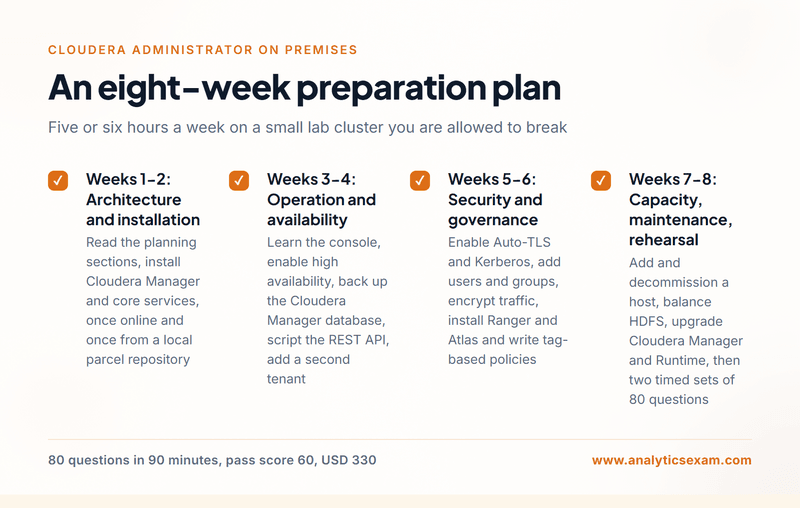
Weeks one and two belong to architecture and installation. Read the deployment planning and architecture sections of the documentation, then install Cloudera Manager and a minimal set of core services on your lab, once from internet-connected hosts and once from a local parcel repository to understand the isolated-network case. Keep notes on every prerequisite the installer checks, because those checks are exactly the kind of detail the exam asks about.
Weeks three and four cover operation and availability. Learn the Cloudera Manager console properly: health tests, charts, configuration search, the stale-configuration warnings, log collection and the diagnostic bundle. Then configure high availability for the name node and resource manager, set up a backup of the Cloudera Manager database and a replication schedule, and try the REST API from a script. Finish by defining a second tenant with its own YARN queue and resource pool so that multi-tenancy is something you have done rather than read about.
Weeks five and six are security and governance. Enable Auto-TLS, then enable Kerberos through the wizard against a lab KDC, and read what each one created. Add users and groups, confirm that service web consoles now require authentication, and turn on encryption for data in transit on at least one service. Install Ranger and Atlas, write a handful of resource-based and tag-based policies, and create a classification in Atlas to see how it reaches Ranger.
Weeks seven and eight are capacity, maintenance and rehearsal. Add a host, decommission it, run the HDFS balancer and check the result, then tune a YARN queue. Perform an upgrade of Cloudera Manager and Cloudera Runtime on the lab, following the documented order, and apply a patch. In the last week sit at least two full-length timed sets of 80 questions, review every wrong answer against the documentation, and go back to the topic that cost you the most. Candidates who do a timed rehearsal before the real exam report far fewer surprises with the pacing.
If you cannot get a lab at all, the preparation takes longer and leans on documentation and recorded course material, but it is still possible. In that case double the time spent on the security and operations topics, because those are the ones where reading alone leaves the largest gap.
How does it compare with the public cloud administrator and the Generalist exams?
Cloudera's current certification line has three exams that an administrator might consider. The on-premises administrator exam covered here is one. The Cloudera Certified Administrator for public cloud is its sibling, aimed at people who run Cloudera on AWS, Azure or Google Cloud where the control plane, environments and data lakes are managed differently and much of the installation work disappears. The CDP Generalist exam is the entry-level credential that covers the whole platform at a conceptual level for any role.
Choose between the two administrator exams by where your clusters live, not by which seems easier. The on-premises exam asks far more about installation, parcels, Kerberos, TLS and host maintenance, because on-premises administrators do that work themselves. The public cloud exam asks more about environments, credentials, data lake services and the cloud provider's own networking and storage. An administrator who runs both kinds of estate will eventually want both, and the shared concepts, Ranger, Atlas, YARN and the Cloudera Manager console, mean the second is quicker to prepare for than the first.
The Generalist exam is not a prerequisite, and an experienced administrator can skip it. It is a reasonable first step for the Linux administrator moving onto a platform team who wants to learn the vocabulary before committing to the longer administrator preparation, and it is the right choice for team members in adjacent roles who need to understand the platform without administering it.
What does the credential change after you pass?
The honest answer is that it changes different things for different candidates. For the in-house administrator it is mostly a signal to their own management and to internal audit that the person running a regulated data platform has been independently assessed. Several organisations with on-premises Cloudera estates now list the certification as desired or required for platform roles, and it appears in job advertisements for Hadoop and Cloudera administrators in financial services and telecoms.
For consultants and partners the change is more direct. Certified staff count toward partner status, and clients evaluating a statement of work can see that the people installing their cluster have passed a vendor exam on exactly that task. That tends to shorten procurement conversations and justify a higher day rate for the certified engineer.
For the career-changer it is a credential that says the move from general Linux administration to data platform administration is complete. Combined with a few months of documented hands-on work, it is usually enough to be interviewed for platform roles that previously asked for Cloudera experience the candidate did not have.
Whatever your situation, the credential is worth more if you keep it current. Cloudera's platform versions move, the documentation the exam references is tied to a release, and a certification earned on one major version is a stronger claim when you can also show you have upgraded a cluster to the next one. Treat the exam as the point where your knowledge is verified, not the point where you stop learning the platform.
Is the exam worth the fee for your situation?
At USD 330 the exam costs less than a single day of most Cloudera consulting rates and far less than either of the suggested courses. The real investment is the forty or fifty hours of preparation and the lab you build to practise on. If you administer Cloudera on premises today, that investment mostly turns existing skill into something you can prove, and it is hard to argue against. If you are moving into the role, the structured preparation is itself most of the value, and the exam is the way to show the move is done. If your work is on the public cloud edition or on the data engineering side of the platform, spend the fee on the exam that matches your work instead.
Whichever group you are in, know the nine topics and their weights before you start, build or borrow a lab, and rehearse under the 90-minute clock at least twice. Candidates who do those three things rarely need a second attempt.
Frequently Asked Questions
How many questions are on the Cloudera Administrator on premises exam and how long does it last?
The exam has 80 questions and a 90-minute time limit, which leaves a little under 70 seconds per question. It is delivered online with a proctor through Questionmark, and no reference material of any kind is allowed while you sit it, so pacing and recall both matter.
What is the pass score and the fee for the Cloudera on-premises administrator exam?
Cloudera's exam guide lists a pass score of 60, and the exam costs USD 330. Cloudera does not publish how many of the 80 questions are unscored or state a retake policy on the guide page, so prepare on the assumption that every question counts and that one attempt should be enough.
Which topics carry the most weight on the exam?
Architecture is the largest topic at 14 percent. Four more share 12.5 percent apiece: high-availability planning, install and deploy, day-to-day cluster operation, and the security configuration work around TLS and Kerberos. Governance, capacity management, and HDFS and YARN administration are 10 percent each, and cluster maintenance is 6 percent.
Do I need a running Cloudera cluster to prepare for the exam?
A production cluster is not required, but a small lab is strongly recommended. Three or four virtual machines are enough to install Cloudera Manager, enable Kerberos and Auto-TLS, add Ranger and Atlas, and rehearse an upgrade. Candidates who prepare from documentation alone usually need more time on the security and operations topics.
Should I take the on-premises administrator exam or the public cloud administrator exam?
Choose by where your clusters run. The on-premises exam concentrates on installation, parcels, Kerberos, TLS, host maintenance and isolated networks, because on-premises administrators handle that work themselves. The public cloud exam concentrates on environments, credentials, data lake services and the cloud provider's networking and storage.
Is the CDP Generalist certification a prerequisite for the administrator exam?
No. There is no prerequisite certification, and an experienced administrator can go straight to the administrator exam. The Generalist exam suits Linux administrators who are new to the platform and want its vocabulary first, and team members in adjacent roles who need to understand Cloudera without administering it.


