
Qlik AI Specialist Certification: A Beginner's Step-by-Step Guide
 The Qlik AI Specialist Certification (QAIS) validates a professional's foundational understanding and practical skills in applying artificial intelligence concepts within the Qlik ecosystem. This credential, offered by Qlik, is specifically designed for individuals looking to leverage Qlik's AI capabilities, such as Qlik Answers, Qlik Machine Learning, and Insight Advisor, to derive deeper insights and automate data-driven decisions. Aspiring data analysts, business intelligence developers, and technical professionals keen on integrating AI into their analytics workflows will find this certification a valuable step in their career progression. This comprehensive guide will walk you through the certification journey, detailing the exam structure, syllabus, preparation strategies, and the impactful benefits of becoming a Qlik AI Specialist.
Charting Your Path to Qlik AI Expertise
The Qlik AI Specialist Certification signifies a robust understanding of how AI integrates with Qlik's powerful analytics platform. This certification is ideal for individuals who are enthusiastic about applying machine learning principles and AI-driven insights to real-world business challenges using Qlik technologies. Earning this credential confirms your capability to deploy AI solutions that enhance data analysis, automate reporting, and empower users with intelligent data discovery. It’s a foundational step that opens doors to advanced roles in data science and AI within organizations utilizing Qlik.
Understanding the QAIS Exam Structure
Successfully navigating the Qlik AI Specialist Certification exam requires a clear understanding of its format and administrative details. The exam, identified by code QAIS, assesses your practical and theoretical knowledge across several key AI domains relevant to Qlik’s platform. These foundational details help candidates prepare effectively, knowing what to expect on exam day.
The Qlik AI Specialist Certification exam costs $250 (USD). Candidates are allocated 120 minutes to complete the exam, which consists of 50 questions. To achieve the certification, a passing score of 73% is required. These parameters underscore the need for thorough preparation and efficient time management during the assessment. Understanding these specifics allows candidates to plan their study schedule and practice exams more strategically.
Mastering the AI Domains with Qlik
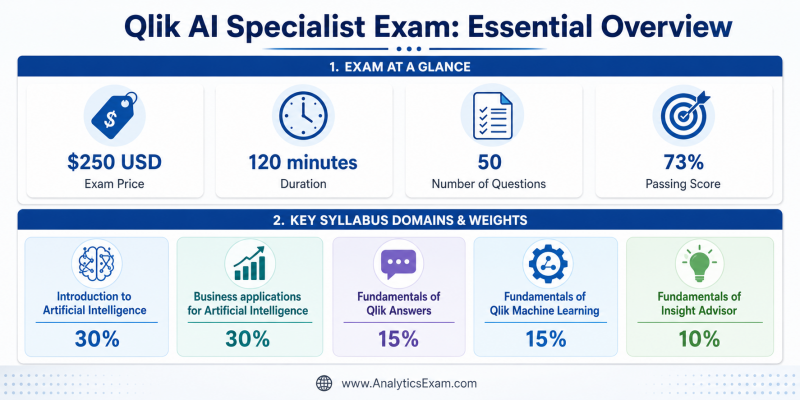
The Qlik AI Specialist Certification (QAIS) covers a well-defined syllabus designed to equip candidates with comprehensive knowledge of AI fundamentals and their specific applications within the Qlik environment. Each domain carries a particular weight, indicating the depth of coverage and the importance of each topic. A balanced preparation approach, considering these weightages, is crucial for success.
The QAIS exam evaluates proficiency across the following critical areas:
-
Introduction to Artificial Intelligence (30%): This section lays the groundwork, covering core AI concepts, historical context, key terminology, and the various branches of AI. It delves into understanding what AI is, its potential, and ethical considerations.
-
Business applications for Artificial Intelligence (30%): Focusing on real-world scenarios, this domain explores how AI can be leveraged to solve business problems, drive innovation, and create competitive advantages. It includes use cases in areas like predictive analytics, customer service, and operational efficiency.
-
Fundamentals of Qlik Answers (15%): Candidates will learn about Qlik Answers, its capabilities in natural language processing (NLP), and how it enables conversational analytics and intelligent self-service data exploration within Qlik applications.
-
Fundamentals of Qlik Machine Learning (15%): This part covers the basics of machine learning within the Qlik platform, including common algorithms, model deployment, and how Qlik's tools facilitate the creation and integration of ML models for enhanced insights.
-
Fundamentals of Insight Advisor (10%): The Insight Advisor, Qlik's AI assistant, is explored in this section, focusing on its role in guiding users to discover hidden patterns, generate automated insights, and recommend visualizations based on data context.
Understanding these areas is paramount for any candidate aspiring to gain Qlik AI Specialist Certification.
The Value Proposition of AI Competency
Acquiring the Qlik AI Specialist Certification offers a substantial boost to your professional profile, demonstrating a forward-thinking skill set in a rapidly evolving technological landscape. This certification not only validates your technical expertise but also showcases your ability to bridge the gap between complex AI concepts and practical business solutions using Qlik. In today's data-intensive world, professionals who can harness AI to unlock deeper insights are in high demand across various industries.
The benefits extend beyond individual career growth, impacting organizational success as well.
-
Enhanced Career Opportunities: Certified professionals are better positioned for roles in data science, AI engineering, business intelligence, and advanced analytics, where AI integration is becoming standard.
-
Increased Credibility and Recognition: The QAIS certification acts as a badge of honor, distinguishing you from peers and signaling to employers your commitment to advanced analytics skills and professional development.
-
Deeper Analytical Insights: With a strong grasp of Qlik's AI features, you can develop more sophisticated analytics applications that provide predictive capabilities, uncover hidden patterns, and automate decision-making processes.
-
Contribution to Business Innovation: Your expertise will enable organizations to implement AI-driven strategies that optimize operations, improve customer experience, and foster innovative data exploration.
-
Stay Ahead of the Curve: The field of AI is constantly advancing. Earning this certification ensures you are up-to-date with current technologies and best practices for integrating AI into business intelligence.
This credential opens doors to significant professional advancement and contributes directly to modern data-driven strategies.
Crafting a Strategic Study Plan for QAIS Success
Effective preparation is the cornerstone of passing the Qlik AI Specialist Certification exam. A well-structured study plan not only covers all the required topics but also includes practical application and self-assessment to ensure readiness. Given the diverse nature of the syllabus, integrating various learning resources and methodologies will yield the best results. A strategic approach involves understanding the content, practicing diligently, and building confidence for exam day.
Leveraging Official Qlik Resources
Start your preparation by exploring the wealth of materials provided by Qlik itself. The official Qlik exam page is an invaluable resource, offering detailed outlines, recommended learning paths, and sometimes even free training modules or webinars. These resources are tailored to the exam objectives and provide the most accurate information.
Engaging with Diverse Learning Materials
Beyond official documentation, consider a mix of learning formats to solidify your understanding.
-
Online Courses: Platforms offering structured courses on AI fundamentals, machine learning, and Qlik-specific applications can provide a comprehensive learning experience. Look for courses that include hands-on labs.
-
Documentation and Whitepapers: Dive into Qlik's product documentation for Qlik Answers, Qlik Machine Learning, and Insight Advisor. Whitepapers and technical blogs often offer deeper insights into specific functionalities and use cases.
-
Community Forums: Engage with the Qlik community. Asking questions, sharing insights, and learning from experienced users can provide practical context and troubleshooting tips that theoretical study might miss.
-
Practice Exams and Sample Questions: To truly gauge your readiness and familiarize yourself with the exam format, taking Qlik AI sample questions is essential. These mock tests help identify areas needing further review and improve your time management skills. You can find comprehensive practice questions and study guides to aid in your preparation for the Qlik AI certification path on AnalyticsExam.com.
Remember, consistent and varied study habits are key to mastering the complex topics of AI and Qlik integration.
Applying AI Capabilities in Qlik Environments
The Qlik AI Specialist Certification not only tests your theoretical knowledge but also your ability to practically apply AI functionalities within Qlik applications. This involves understanding how to configure, utilize, and troubleshoot features like Qlik Answers, Qlik Machine Learning, and Insight Advisor to solve real-world business intelligence problems. Proficiency in this area transforms raw data into actionable insights, making you an invaluable asset in any data-driven organization.
Integrating Qlik Answers for Conversational Analytics
Qlik Answers revolutionizes data interaction by enabling natural language processing (NLP). As a certified specialist, you'll be capable of:
-
Configuring Natural Language Queries: Setting up Qlik Sense applications to respond to natural language questions, allowing users to query data using everyday language.
-
Enhancing User Experience: Providing a more intuitive and accessible way for business users to explore data without needing deep technical knowledge of data models or query languages.
-
Automating Insight Discovery: Using Qlik Answers to automatically generate relevant insights and visualizations based on conversational input, accelerating the data analysis process.
This capability is crucial for fostering a self-service analytics culture and empowering a broader range of users.
Leveraging Qlik Machine Learning for Predictive Insights
Qlik Machine Learning empowers users to build, deploy, and manage machine learning models directly within the Qlik platform. Your role as a QAIS specialist includes:
-
Building and Training Models: Understanding basic ML algorithms and how to prepare data for model training within Qlik.
-
Deploying Predictive Solutions: Integrating ML models into Qlik applications to provide predictive analytics, such as sales forecasting, customer churn prediction, or anomaly detection.
-
Interpreting Model Outputs: Explaining the results of ML models to business stakeholders in an understandable way, translating complex outputs into actionable intelligence.
These skills are vital for organizations looking to move beyond descriptive analytics to predictive and prescriptive insights.
Optimizing Data Exploration with Insight Advisor
The Insight Advisor acts as an intelligent guide, assisting users in discovering valuable insights. As a Qlik AI Specialist, you will know how to:
-
Guide Data Discovery: Utilize Insight Advisor to automatically suggest charts, identify trends, and highlight key data points based on user selections and data context.
-
Customize Insight Generation: Tailor the Insight Advisor's behavior to meet specific analytical needs, ensuring it generates the most relevant insights for different business scenarios.
-
Improve Data Literacy: Empower users by providing them with AI-driven recommendations that help them understand complex data relationships and build more effective dashboards.
Mastering Insight Advisor greatly enhances the speed and quality of data exploration, making analytics more efficient and accessible for everyone.
Troubleshooting and Best Practices for Qlik AI Deployments
Beyond simply knowing how to use Qlik's AI features, a true specialist understands the nuances of deployment, recognizing common pitfalls, and implementing best practices for optimal performance and reliable insights. This includes ensuring data quality, ethical AI use, and ongoing maintenance. Troubleshooting skills are particularly valuable, allowing for the quick resolution of issues that may arise in complex AI-driven analytical environments.
Ensuring Data Quality and Ethical AI Use
The accuracy and reliability of AI outputs are directly tied to the quality of the input data. As a Qlik AI Specialist, your responsibilities include:
-
Data Preprocessing: Implementing best practices for cleaning, transforming, and preparing data to ensure it is suitable for AI and machine learning models, minimizing bias and inaccuracies.
-
Bias Detection and Mitigation: Understanding how biases in data can lead to unfair or inaccurate AI predictions and applying strategies to detect and mitigate these biases within Qlik.
-
Ethical Guidelines: Adhering to ethical principles in AI development and deployment, ensuring that AI-driven insights are used responsibly and transparently, respecting privacy and fairness.
These considerations are paramount for building trust in AI-powered solutions.
Maintaining and Optimizing AI Models in Qlik
AI models are not static; they require continuous monitoring and optimization to remain effective. Your expertise will cover:
-
Model Monitoring: Setting up dashboards and alerts within Qlik to monitor the performance of deployed ML models, tracking key metrics like accuracy, precision, and recall.
-
Retraining Strategies: Developing strategies for when and how to retrain models with new data to maintain their relevance and predictive power, adapting to evolving business landscapes.
-
Performance Tuning: Identifying opportunities to optimize the performance of Qlik AI components, ensuring efficient resource utilization and quick response times for analytical queries.
Proactive maintenance ensures that your AI investments continue to deliver value over time.
Beyond Certification: Continuous Learning in AI and Analytics
Earning the Qlik AI Specialist Certification is a significant achievement, but it also marks the beginning of a continuous learning journey in the dynamic fields of artificial intelligence and analytics. The technological landscape evolves rapidly, with new algorithms, tools, and best practices emerging regularly. Staying current is crucial to maintaining your edge and maximizing the value you bring to your organization.
Engaging with Industry Trends and Innovations
To remain a leading expert, you must actively follow developments in AI and machine learning.
-
Industry Publications: Regularly read leading AI and data science journals, blogs, and news outlets to stay informed about breakthroughs and emerging technologies.
-
Conferences and Webinars: Attend virtual or in-person conferences and webinars focused on AI, machine learning, and business intelligence. These events offer insights from thought leaders and networking opportunities.
-
Online Learning Platforms: Continue to explore advanced courses on topics such as deep learning, reinforcement learning, or specialized AI applications that complement your Qlik expertise.
Cultivating a habit of continuous learning will ensure your skills remain relevant and sought-after.
Contributing to the Qlik Community and Beyond
Sharing your knowledge and engaging with others can deepen your understanding and enhance your professional network.
-
Mentoring and Coaching: Help others who are new to Qlik AI. Explaining concepts to beginners often reinforces your own understanding and identifies areas for further study.
-
Community Participation: Actively participate in Qlik forums, online groups, and local user meetups. Contribute to discussions, share solutions, and learn from the collective experience of the community.
-
Personal Projects: Apply your Qlik AI skills to personal projects or open-source initiatives. These hands-on experiences can uncover new challenges and creative solutions, enhancing your practical expertise.
This proactive engagement fosters a cycle of learning and contribution, solidifying your status as an expert in the field.
Conclusion
The Qlik AI Specialist Certification offers a clear and structured pathway for professionals eager to harness the power of artificial intelligence within Qlik's analytics platform. By validating your skills in key areas from AI fundamentals to practical applications of Qlik Answers, Qlik Machine Learning, and Insight Advisor, this credential positions you as a valuable asset in the modern data-driven workforce. It signifies not just technical proficiency but also a commitment to leveraging intelligent solutions for deeper business insights and innovation.
Taking this step can profoundly impact your career trajectory, opening new opportunities and enhancing your credibility. Embrace the challenge of preparation, commit to continuous learning, and elevate your expertise. To further aid your preparation and explore comprehensive practice resources, visit Qlik certification resources. Your journey to becoming a certified Qlik AI Specialist begins now.
Frequently Asked Questions
1. Who should consider pursuing the Qlik AI Specialist Certification?
This certification is ideal for data analysts, business intelligence developers, and technical professionals who wish to integrate AI capabilities into their Qlik analytics workflows. It’s also suitable for those looking to validate their foundational knowledge in AI as applied to the Qlik platform.
2. What foundational knowledge is recommended before attempting the QAIS exam?
While this is a beginner's guide, a basic understanding of data analytics concepts, experience with Qlik Sense, and a general familiarity with data handling are typically beneficial. The certification itself covers core AI concepts from the ground up.
3. How long does the Qlik AI Specialist Certification remain valid?
Certification validity periods vary by vendor and specific certification. Qlik certifications typically require recertification after a certain period, often 2-3 years, to ensure specialists remain current with evolving product features and industry best practices. Please consult the official Qlik certification policies for precise details.
4. Are there any prerequisites for taking the QAIS exam?
Qlik generally designs its specialist certifications to validate specific skill sets rather than requiring formal prerequisites. However, practical experience with Qlik Sense and familiarity with data concepts will significantly enhance your chances of success.
5. What kind of career opportunities can the Qlik AI Specialist Certification open?
Earning this certification can lead to enhanced roles in data analysis, business intelligence, data science, and AI-focused positions. It demonstrates your ability to apply AI to uncover deeper insights and drive intelligent decisions, making you a competitive candidate in various industries.
- Qlik Certification |
- QAIS |
- QAIS Questions |
- QAIS Sample Questions |
- QAIS Questions and Answers |
- QAIS Test |
- Qlik AI Specialist Certification Online Test |
- Qlik AI Specialist Certification Sample Questions |
- Qlik AI Specialist Certification Exam Questions |
- Qlik AI Specialist Certification Simulator |
- QAIS Practice Test |
- Qlik AI Specialist Certification |
- QAIS Study Guide |
- QAIS Certification |
- QAIS Syllabus |
- Exam QAIS Study Material |
- QAIS Books |
- Qlik AI Specialist Certification Syllabus |
- Qlik AI Specialist Certification Mock Test |
- Qlik AI Specialist Certification Books |
- Qlik AI Specialist Certification Training |
- QAIS PDF |
- Qlik AI Specialist Certification Quiz |
- Qlik AI Specialist Certification Question Bank |
- Qlik AI Specialist Certification Questions and Answers


