
The Proven Path to Salesforce Analytics-Con-301 Success

The Salesforce Analytics-Con-301 certification, officially known as the Salesforce Certified Tableau Consultant exam, validates a candidate's expertise in leading the successful implementation of Tableau solutions. This credential is designed for experienced professionals who possess a deep understanding of the Tableau platform, data visualization best practices, and the consulting skills required to deliver impactful analytical solutions. Professionals aiming for this certification typically work with clients to assess their analytical needs, design robust data architectures, implement complex calculations, and ensure effective governance of published content. This comprehensive article will navigate the intricacies of the Analytics-Con-301 exam, outline its key domains, highlight the benefits of certification, and provide actionable strategies to ensure a successful preparation journey.
Understanding the Salesforce Analytics-Con-301 Credential
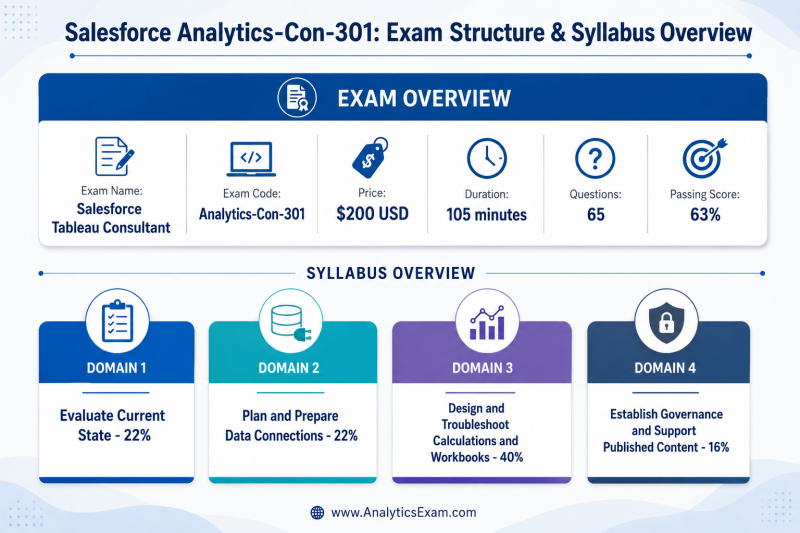
The Salesforce Analytics-Con-301 exam serves as a critical benchmark for professionals seeking to demonstrate their advanced consulting and implementation capabilities within the Tableau ecosystem. Achieving this certification signifies that an individual possesses the practical knowledge and strategic acumen to guide organizations in leveraging Tableau for data-driven decision-making. It’s a testament to one's ability to translate business requirements into effective, scalable Tableau solutions.
The structure of the Analytics-Con-301 exam is precisely defined to evaluate a broad range of skills:
-
Exam Name: Salesforce Tableau Consultant
-
Exam Code: Analytics-Con-301
-
Exam Price: $200 (USD)
-
Duration: 105 minutes
-
Number of Questions: 65 multiple-choice questions
-
Passing Score: 63%
These parameters indicate a challenging assessment requiring not just theoretical knowledge but also practical application and problem-solving skills across various Tableau functionalities and consulting scenarios. Candidates must manage their time effectively during the exam, ensuring they can address each question thoroughly within the allotted duration. Familiarity with the exam format and question types is crucial for minimizing surprises on test day.
Dissecting the Analytics-Con-301 Syllabus Domains
A thorough understanding of the Analytics-Con-301 syllabus is the cornerstone of effective preparation. The exam objectives are weighted across four key domains, each representing a critical area of expertise for a Tableau Consultant. Mastering these domains ensures a balanced and comprehensive skill set, essential for real-world application and exam success. Professionals can find a more detailed exam guide on the official Trailhead website.
Evaluating Current State (22%)
This domain focuses on the initial discovery and assessment phase of a Tableau implementation project. Consultants must be adept at understanding a client's existing analytical landscape, identifying pain points, and gathering detailed requirements. This includes evaluating data sources, existing reporting structures, and user needs to form a clear project scope and strategy. Key tasks involve stakeholder interviews, documentation review, and identifying opportunities for improvement through Tableau.
Planning and Preparing Data Connections (22%)
Data is the foundation of any analytical solution, and this section emphasizes the consultant's ability to design, implement, and optimize data connections within Tableau. It covers various data sources, connection types (live vs. extract), data blending, and ensuring data quality and security. Candidates should demonstrate proficiency in preparing data for analysis, understanding the implications of different connection strategies on performance, and troubleshooting common data-related issues.
Designing and Troubleshooting Calculations and Workbooks (40%)
As the largest section, this domain highlights the core technical capabilities required to build effective and interactive Tableau workbooks. It encompasses a wide range of topics, from creating basic and advanced calculations (including LOD expressions) to designing compelling visualizations, dashboards, and stories. The ability to troubleshoot complex calculation errors, optimize workbook performance, and ensure best practices in design is paramount. This section demands hands-on experience and a deep understanding of Tableau's analytical functions.
Establishing Governance and Support Published Content (16%)
Beyond initial deployment, a Tableau Consultant is responsible for ensuring the long-term success and maintainability of solutions. This domain addresses the principles of content governance, including security permissions, user management, scheduling refreshes, and monitoring usage. It also covers strategies for providing ongoing support, documentation, and training to end-users, ensuring that published content remains reliable, accessible, and performs optimally.
Unlocking Career Advancement with Tableau Expertise
Earning the Salesforce Analytics-Con-301 certification is more than just passing an exam; it's a strategic move that can significantly accelerate a professional's career trajectory. This credential distinguishes individuals as highly skilled Tableau practitioners and consultants, capable of delivering tangible value to organizations. The demand for data professionals who can not only use but also consult on and implement advanced analytics tools like Tableau continues to grow across industries.
Enhanced Job Prospects and Earning Potential
Certified Tableau Consultants are highly sought after in the job market. This certification signals to employers a candidate's validated ability to tackle complex data challenges, leading to opportunities in consulting firms, enterprise data teams, and leadership roles. The specialized skills endorsed by the Analytics-Con-301 credential often correlate with higher earning potential compared to uncertified professionals in similar roles. It positions you as a trusted advisor in the data analytics space, opening doors to more challenging and rewarding projects.
Validation of Specialized Skills
The Analytics-Con-301 certification formally validates a comprehensive skill set that extends beyond basic Tableau usage. It confirms expertise in areas such as client needs assessment, robust data architecture design, advanced analytical expression, and scalable content governance. This official endorsement provides a competitive edge, reassuring clients and employers of your capacity to deliver sophisticated, production-ready Tableau solutions. It demonstrates a commitment to professional development and a mastery of the end-to-end Tableau implementation lifecycle.
Contributing to Data-Driven Decisions
At its core, the Tableau Consultant role is about empowering organizations with actionable insights. By achieving this certification, professionals become instrumental in transforming raw data into strategic intelligence. This enables businesses to make more informed decisions, optimize operations, and identify new growth opportunities. The ability to consult, design, and implement effective Tableau solutions directly contributes to an organization's analytical maturity and competitive advantage, making certified consultants invaluable assets.
Charting Your Study Plan for Analytics-Con-301 Mastery
Effective preparation for the Salesforce Analytics-Con-301 exam requires a structured and disciplined approach. Given the breadth and depth of the syllabus, candidates should develop a detailed study plan that allocates sufficient time to each domain while also emphasizing hands-on practice. A well-executed strategy will not only lead to certification success but also solidify the practical skills required in a consulting role.
Leveraging Official Salesforce Resources
Salesforce provides a wealth of resources designed to support candidates in their certification journey. The official certification page on Trailhead Academy is the primary source for the most accurate and up-to-date information regarding exam objectives, prerequisites, and recommended training courses. Exploring relevant Trailhead modules and Superbadges related to Tableau administration, development, and consulting will provide foundational knowledge and practical application scenarios. These resources are invaluable for understanding Salesforce's perspective on best practices and solution design.
Mastering Key Concepts Through Practice
Theoretical knowledge alone is insufficient for this exam. Candidates must gain extensive hands-on experience with Tableau Desktop and Tableau Server/Cloud. This involves:
-
Building diverse visualizations: Experiment with various chart types, dashboards, and interactive elements.
-
Implementing complex calculations: Practice with table calculations, LOD expressions, and parameters to solve real-world analytical problems.
-
Connecting to various data sources: Work with different databases, flat files, and cloud data sources to understand connection types and data preparation techniques.
-
Optimizing performance: Learn to identify and resolve performance bottlenecks in workbooks and data connections.
-
Configuring governance features: Practice setting up site roles, permissions, schedules, and monitoring usage on Tableau Server/Cloud.
Utilizing practice exams and mock tests can help gauge readiness, identify knowledge gaps, and familiarize candidates with the exam format. For comprehensive study tools and practice tests designed to replicate the exam experience, consider resources like those found on VMExam.com. This approach ensures you are not only knowledgeable but also agile in applying your skills under timed conditions.
Importance of Practical Experience
The Analytics-Con-301 exam is explicitly designed for consultants with practical experience. It is not an entry-level certification. Prior experience in real-world Tableau implementation projects, client engagement, and solution design is crucial. If you lack direct consulting experience, consider volunteering for projects, taking on more advanced roles in your current position, or participating in community initiatives to bridge this gap. Practical exposure will help you understand the nuances of problem-solving and decision-making in a Tableau consulting context, which is heavily tested in the exam.
Avoiding Unethical Study Materials
While preparing for any certification, it is paramount to uphold ethical standards. Relying on "exam dumps" or unauthorized materials undermines the integrity of the certification and diminishes the value of your achievement. These materials often contain outdated or incorrect information and do not foster genuine understanding of the subject matter. Focus on building authentic knowledge and skills through legitimate study resources, hands-on practice, and official documentation. Ethical preparation ensures long-term professional credibility and true competency.
Identifying Ideal Candidates for Tableau Consultant Certification
The Salesforce Analytics-Con-301 certification targets a specific profile of data professional. It's not merely for Tableau users, but for those who aspire to or already function in a consulting capacity, guiding organizations through complex data visualization and analytics challenges. Understanding if you fit this profile is the first step in determining if this certification is the right path for your career development.
The ideal candidate for the Salesforce Tableau Consultant certification typically possesses:
-
Extensive Tableau experience: Several years of hands-on experience designing, developing, and deploying Tableau solutions in diverse environments.
-
Strong analytical and problem-solving skills: The ability to deconstruct complex business problems, translate them into analytical requirements, and design effective Tableau solutions.
-
Consulting acumen: Experience interacting with stakeholders, gathering requirements, presenting solutions, and managing client expectations.
-
Data warehousing and ETL knowledge: A foundational understanding of data architecture, data governance, and extract, transform, load (ETL) processes is highly beneficial.
-
Familiarity with Salesforce ecosystem: While not strictly a Salesforce product, understanding how Tableau integrates with Salesforce data sources can be a significant advantage.
This certification is particularly beneficial for data consultants, senior Tableau developers, business intelligence architects, and data strategists who lead analytical projects and are responsible for the full lifecycle of Tableau implementations. It signifies a readiness to take on advanced roles that demand both technical prowess and strategic insight.
Cultivating Core Skills for Analytics-Con-301 Success
Passing the Analytics-Con-301 exam requires more than rote memorization; it demands the cultivation of a robust set of skills directly applicable to real-world Tableau consulting engagements. These skills span technical proficiency, analytical thinking, and client management, making the certified professional a versatile asset. Developing these competencies ensures not only exam success but also long-term career effectiveness.
Data Assessment and Requirements Gathering
A foundational skill is the ability to effectively assess a client's current data landscape and thoroughly gather requirements. This involves asking the right questions, identifying key performance indicators (KPIs), understanding business processes, and documenting data needs. A skilled consultant can navigate ambiguous requirements, prioritize needs, and translate abstract business challenges into concrete data visualization objectives. This initial phase sets the stage for the entire project, and mistakes here can propagate throughout the development cycle.
Data Preparation and Connectivity Mastery
Proficiency in connecting to, transforming, and preparing data for optimal Tableau consumption is paramount. This includes:
-
Understanding various data connection types (live, extract, custom SQL).
-
Mastering data blending and joining techniques to integrate disparate sources.
-
Implementing data cleaning and transformation using Tableau Prep or other ETL tools.
-
Ensuring data security and performance considerations for large datasets.
The ability to build efficient and reliable data models is critical for delivering high-performing and accurate Tableau solutions. This domain often involves troubleshooting complex data integration issues and optimizing data pipelines for scalability.
Advanced Calculation and Visualization Techniques
The exam heavily emphasizes the ability to design sophisticated calculations and create impactful visualizations. This means moving beyond basic charts to:
-
Crafting complex Level of Detail (LOD) expressions for intricate aggregations.
-
Utilizing parameters and sets for dynamic analysis.
-
Developing interactive dashboards with effective actions and filters.
-
Applying advanced charting techniques to convey complex information clearly.
-
Optimizing workbook design for user experience and performance.
A certified consultant can not only create visually appealing dashboards but also ensure they are analytically sound, address specific business questions, and provide actionable insights. This requires a deep understanding of Tableau's functional capabilities and an eye for effective data storytelling.
Content Management and Governance Best Practices
Finally, effective content management and governance are crucial for the long-term success of any Tableau deployment. This skill involves:
-
Implementing robust security models using roles, permissions, and row-level security.
-
Establishing clear processes for content publishing, promotion, and deprecation.
-
Monitoring Tableau Server/Cloud usage and performance to ensure optimal operation.
-
Providing training and documentation to empower users and foster self-service analytics.
A consultant must guide clients in building a sustainable Tableau environment that balances accessibility with control, ensuring data integrity and user adoption. This proactive approach to governance prevents common pitfalls and maximizes the return on investment in Tableau.
Refining Exam Day Readiness
The journey to Salesforce Analytics-Con-301 success culminates on exam day. While comprehensive preparation is essential, strategic planning for the exam itself can significantly improve performance. Approaching the test with a clear mind, effective time management, and a solid understanding of the question format can make a crucial difference.
Before the exam, ensure you are well-rested and have a comfortable testing environment if taking it remotely. Familiarize yourself with the online proctoring requirements to avoid any technical glitches that could cause delays or stress. During the exam, practice effective test-taking strategies:
-
Read each question carefully: Pay close attention to keywords and specific requirements. Many questions include subtle details that change the correct answer.
-
Eliminate incorrect options: For multiple-choice questions, rule out obviously wrong answers first to increase your chances of selecting the correct one.
-
Manage your time: With 65 questions in 105 minutes, you have roughly 1.6 minutes per question. If a question is too complex, mark it for review and move on to ensure you attempt all questions.
-
Review your answers: If time permits, revisit marked questions and any answers you were unsure about. Sometimes a fresh perspective can reveal errors.
A disciplined approach to the actual test-taking process, combined with thorough preparation, is the ultimate formula for achieving a passing score on the Analytics-Con-301.
Sustaining Expertise Beyond Initial Certification
Achieving the Salesforce Analytics-Con-301 certification is a significant milestone, but it marks the beginning, not the end, of a professional's growth in the Tableau ecosystem. The world of data analytics is constantly evolving, with new features, best practices, and industry trends emerging regularly. Sustaining your expertise ensures that your certification remains a valuable asset throughout your career.
Continuous learning is vital for any Tableau Consultant. This involves:
-
Staying updated with Tableau releases: Regularly review new features and updates released by Tableau.
-
Engaging with the Tableau community: Participate in forums, user groups, and conferences to learn from peers and share knowledge.
-
Exploring advanced topics: Delve deeper into areas like Tableau APIs, embedding, and integration with other platforms.
-
Taking on diverse projects: Seek out new challenges that push your boundaries and expose you to different industries or data complexities.
-
Pursuing further certifications: Consider other specialized Salesforce or data certifications to broaden your skill set.
By actively engaging in ongoing professional development, certified professionals can ensure they remain at the forefront of Tableau consulting, continue to deliver high-impact solutions, and effectively adapt to the changing demands of the analytics landscape.
The Salesforce Analytics-Con-301 certification is a robust credential for professionals aiming to solidify their role as expert Tableau Consultants. It systematically assesses a broad spectrum of skills, from client engagement and data preparation to advanced visualization and governance. The journey towards this certification is a rigorous one, demanding not only technical prowess but also a strategic, consultative mindset. Achieving it unlocks significant career opportunities, validating a skill set crucial for driving data-driven insights in any organization. For those dedicated to mastering Tableau and advancing their consulting career, this certification provides a clear and proven path to success.
To embark on your preparation for the Salesforce Analytics-Con-301 exam with confidence, explore a wealth of resources designed to help you succeed. Leveraging comprehensive study materials and practice tests can significantly enhance your understanding of the core concepts and improve your readiness. For effective exam preparation and a range of valuable study aids, visit VMExam.com and start building your foundation for success today.
Frequently Asked Questions
1. What does the Salesforce Analytics-Con-301 certification validate?
The Salesforce Analytics-Con-301, or Salesforce Certified Tableau Consultant, validates a professional's ability to lead successful Tableau implementations, covering client assessment, data strategy, solution design, and ongoing governance.
2. Is prior consulting experience necessary for the Analytics-Con-301 exam?
While not a strict prerequisite, the exam is designed for experienced professionals, and practical consulting experience with Tableau implementations is highly recommended to understand the real-world application of the tested concepts.
3. How long does the Salesforce Analytics-Con-301 exam take?
The Analytics-Con-301 exam has a duration of 105 minutes, during which candidates must answer 65 multiple-choice questions, requiring efficient time management.
4. What is the passing score for the Salesforce Tableau Consultant exam?
To pass the Salesforce Analytics-Con-301 exam, candidates must achieve a minimum score of 63%.
5. What are the main benefits of becoming a Salesforce Certified Tableau Consultant?
Benefits include enhanced job prospects, higher earning potential, formal validation of advanced Tableau consulting skills, and the ability to drive significant data-driven impact within organizations.
- Salesforce Certification |
- Analytics-Con-301 |
- Analytics-Con-301 Questions |
- Analytics-Con-301 Sample Questions |
- Analytics-Con-301 Questions and Answers |
- Analytics-Con-301 Test |
- Salesforce Tableau Consultant Online Test |
- Salesforce Tableau Consultant Sample Questions |
- Salesforce Tableau Consultant Exam Questions |
- Salesforce Tableau Consultant Simulator |
- Analytics-Con-301 Practice Test |
- Salesforce Tableau Consultant |
- Salesforce Tableau Consultant Certification Question Bank |
- Salesforce Tableau Consultant Certification Questions and Answers |
- Analytics-Con-301 Study Guide |
- Analytics-Con-301 Certification |
- Analytics-Con-301 Syllabus |
- Exam Analytics-Con-301 Study Material |
- Analytics-Con-301 Books |
- Salesforce Tableau Consultant Syllabus |
- Salesforce Tableau Consultant Mock Test |
- Salesforce Tableau Consultant Books |
- Salesforce Tableau Consultant Training |
- Analytics-Con-301 PDF |
- Salesforce Tableau Consultant Quiz |
- Analytics-Con-301 Simulator


